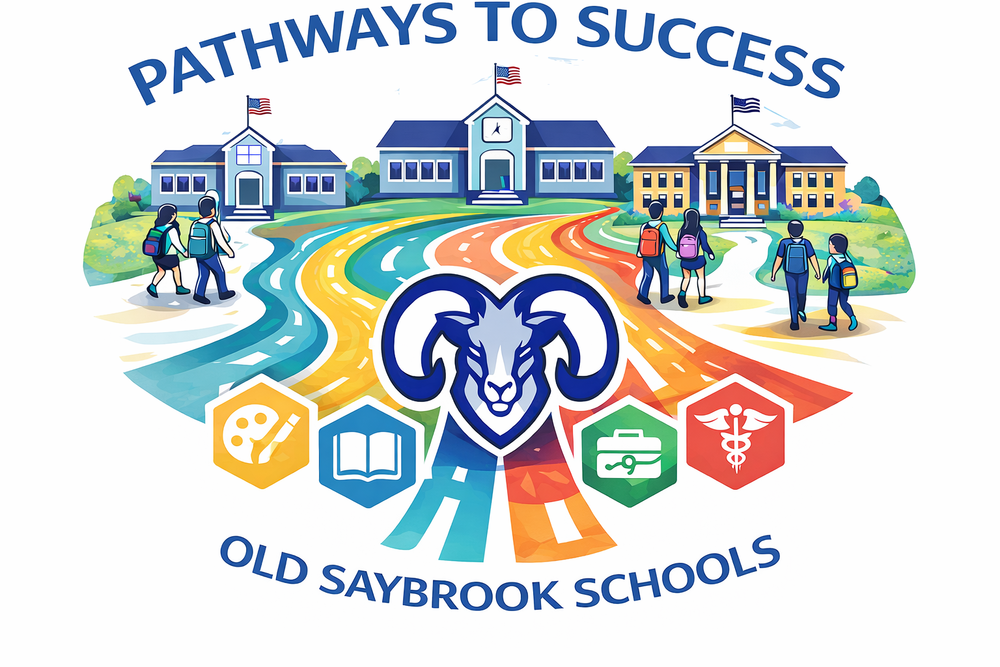
OLD SAYBROOK, Conn. (Jan. 13, 2026) — The Old Saybrook Board of Education voted unanimously Tuesday night to adopt the Old Saybrook Public Schools Strategic Plan 2026–2031, formally launching a districtwide “Pathways” vision designed to strengthen student engagement, modernize learning, and create a more aligned PK–12 experience.
The newly adopted plan, titled “Together, We Build Bright Futures,” lays out a long-term framework that connects the district’s three schools, Goodwin Elementary, Old Saybrook Middle School, and Old Saybrook High School, into a unified journey intended to help students discover their interests, build essential skills, and graduate with purpose.
In a message included at the front of the plan, Superintendent Chris Drezek describes the strategic direction as the product of sustained community listening and a response to a consistent theme: students need more opportunities “to explore who they are, what they love, and what they want their future to be.”
Why the district pursued a new strategy
The plan’s executive overview points to a changing landscape for public education and growing competition for high school enrollment, noting that enrollment has declined by nearly 18% between Grade 8 and Grade 9, with more families choosing magnet, technical, and private school options.
District leaders framed the Pathways work as both a challenge and an opportunity: not simply to compete with neighboring options, but to create a distinct PK–12 model that emphasizes belonging, relevance, and real-world learning.
A PK–12 model built around four pillars
Central to the Strategic Plan is a framework of four districtwide pillars, intended to ensure Pathways is not limited to the high school level but visible and coherent across every grade:
Belonging & Ram Identity
Interest Discovery & Exploration
Academic Skills & Readiness
Real-World Learning & Community Partnerships
The plan describes belonging as the foundation of student success and emphasizes a consistent, districtwide culture in which every student feels “connected, supported, known, and proud to be a Ram.”
Three stages, one pathway system
Rather than defining Pathways as a single program, the Strategic Plan organizes the student experience into three stages:
Stage 1: Foundations (PK–4) at Goodwin Elementary
Stage 2: Exploration (Grades 5–8) at Old Saybrook Middle School
Stage 3: Direction & Opportunity (Grades 9–12) at Old Saybrook High School
At the middle school level, the plan highlights expanded opportunities for interest discovery, including new specials such as Robotics, Musical Theater, Babysitting/Childcare, Personal Finance, and Advanced Science, along with student-led conferences and real-world partnerships.
At the high school, students ultimately select one of five formal Pathways:
Arts
Business
Medical Science
Science, Technology & Engineering
Humanities
The plan also outlines ambitions to expand early college options and career-aligned experiences, including continued growth of UConn ECE offerings, work-based learning, capstones, and a conceptual EMT certification pathway.
Facility concepts included, with budget safeguards
While the plan contains conceptual visions for modernized learning environments, such as a Business Innovation Lab, Medical Science Simulation Center, Arts studios, STEM labs, and a Student Union / collaborative space, it repeatedly emphasizes that these are conceptual only and would be considered through the district’s budgeting and review process.
The Strategic Plan also outlines an implementation approach designed to avoid overpromising: growth is described as capacity-based and readiness-driven, with clear decision-making principles that include alignment, sustainability, and fiscal responsibility.
A clear promise to families and students
The plan includes a districtwide “PK–12 Promise,” stating that every student will have opportunities to discover interests, develop skills, experience real-world learning, build Ram identity, and “graduate with a pathway”, not as a requirement, but as an outcome of a personalized PK–12 experience.
What comes next
With the plan now adopted, district leaders will move toward building the structures and communication tools described in the Strategic Plan, including ongoing updates, community engagement, and a long-term approach to measuring progress through multiple indicators aligned to the four pillars.
As Superintendent Drezek writes in the document’s opening section, the plan is intended to be both ambitious and grounded in community values, reflecting a districtwide commitment to preparing students not only academically, but with direction and confidence for life beyond graduation.